

Journey · 1471–1528
Life
From a goldsmith's workshop in Nuremberg to the courts of Europe — the emergence of the artist as author, theorist and signature.
01
Biography
From Nuremberg to the Low Countries
- 1471
Nuremberg
Born on 21 May in a free imperial city of printers, goldsmiths and merchants — the milieu in which the printed image would become the vector of his fame.
- 1486–1490
Apprenticeship
Trained with Michael Wolgemut: illustrated chronicles, woodcut, the rigour of a reproducible line.
- 1490–1494
Journeyman travels
Colmar, Basel, Strasbourg — building the Rhenish network and the awareness of a master able to sign his work.
- 1495
The workshop
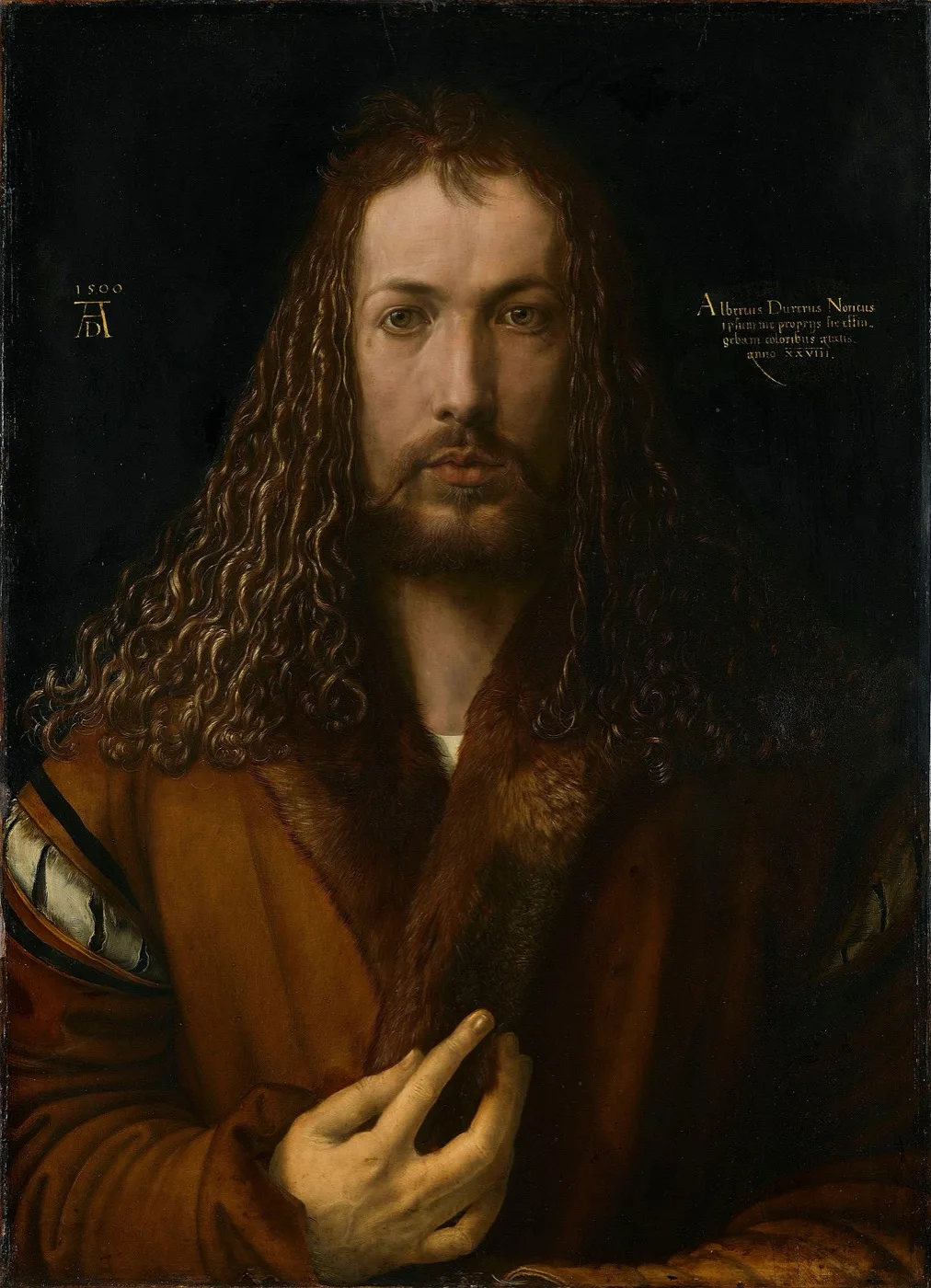
Definitive return, marriage to Agnes Frey, the AD monogram. Painting, drawing and print become complementary activities.
- 1505–1507
Italy
Venice: colour, antiquity, Bellini. The second stay nourished his portraits and a theory of beauty.
- 1513–1514
The master prints
Knight, Death and the Devil, St. Jerome and Melencolia I — the apex of the burin.
- 1520–1521
The Low Countries
Journal, Antwerp, Erasmus — a documented journey through a new artistic world.
- 1525–1528
Treatises & death
Measurement, fortification, the Four Books on Human Proportion; death on 6 April 1528.